0 guesses
- No guesses yet. They will be listed here, closest first.
Solved
- Time
- 0:00
- Guesses
- 0 / 0
- Best
- 0:00
- Streak
- 0
Colordle Unlimited
Play Colordle Unlimited: find a hidden color by typing color names, and each guess scores how close it is, in percent, and there is no limit on guesses. Hard hides one of 4,013 colors.
How to play Colordle
- 1
Type a color name and pick it from the list. Each name in the list has a small swatch, so you can see the color before you guess.
- 2
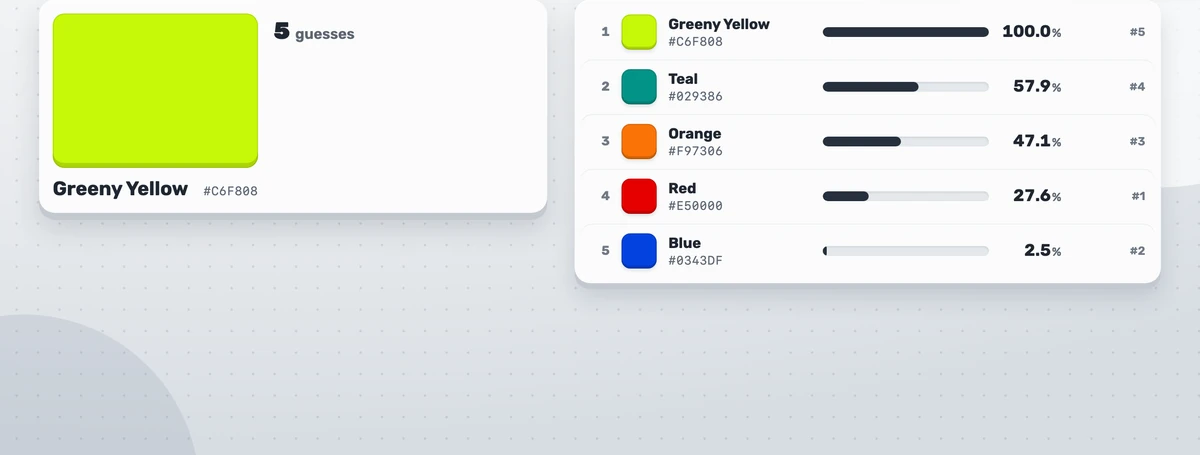
Press Guess. The color goes into your list with its hex code and a percentage for how close it is to the hidden one. The closest guess is always at the top.
- 3
Use Hint when you are stuck, up to 3 times. It compares the hidden color with your closest guess: lighter or darker, which way the hue leans, then more vivid or grayer.
- 4
Keep going until a guess reads 100%. Your score is the number of guesses, and fewer is better.
Colordle tips
- Start with a wide guess in the middle of the rainbow, then split the difference. A first guess at 60% tells you almost nothing about hue, but a second guess in another family quickly shows which side the color is on.
- Compare guesses, not single numbers. If a green scores 70% and a blue scores 40%, the hidden color is nearer the green side. Two guesses that score alike but look different mean the answer sits between them.
- Lightness is worth guessing early. Dark and pale versions of a color can be far apart in percent even when the hue is right, so try the same hue at a different lightness before you change family.
- Take a hint when two or three families still fit. It always compares with your closest guess, so ask for one after a good guess, not after a poor one.
Colordle Unlimited questions
How do you play Colordle?
One color is hidden and you cannot see it. Type a color name, pick it from the list and press Guess. Your guess is added to a list with its swatch, its name, its hex code and a percentage for how close it is to the hidden color, and the closest guess stays on top. Use what the numbers tell you to move toward the color: a guess at 90% is nearly there, one at 50% is far off. When a guess reaches 100% the hidden color is revealed and your guess count is your score. Press Next color for a new one.
Can I play Colordle more than once a day?
Yes. Press Next puzzle for another hidden color at the same level, as often as you like, with no sign-up. A color you played a moment ago is skipped. Switch to Daily if you would rather have the one color everybody gets today at each level.
How is the percentage calculated?
It is based on CIEDE2000, a standard formula from the International Commission on Illumination (CIE) that turns two colors into a single number, ΔE, for how different they look to the eye, so a difference you can hardly see counts for little and an obvious one for a lot. We convert both colors to the CIELAB space, work out ΔE, and show 100 × (1 − ΔE ÷ 100), never below 0, to one decimal place. A guess reads 100% only when its hex code is exactly the hidden color’s, and a different color never rounds up to 100%. We wrote the formula ourselves from the implementation notes that Sharma, Wu and Dalal published in 2005.
Is there a guess limit?
No. You can guess as long as you like, and the game ends only when you find the color. The number of guesses is your score, and the best result for each level is the fewest guesses you have needed (on a tie, the quicker time). Hints do not count as guesses, and neither does a name that is not in the list or one you already tried.
What do Easy, Medium and Hard change?
They change which colors can be hidden and which names you can type. Easy hides one of 235 common colors, such as red, lime or navy, and you can type any of 845 names. Medium hides one of 845 colors from the xkcd list, including two- and three-word names like dusty teal, and accepts 5,489 names. Hard hides one of 4,013 colors with one- or two-word names from the larger list, and accepts 5,504 names. The hints and the percentage work the same on every level.
Where do the color names come from?
From two open lists. The first is the xkcd color survey, where several hundred thousand people named colors on their screens; it is released under CC0 and gives us 845 names after we dropped misspellings and unsuitable names. The second is color-name-list by David Aerne, under the MIT license, which adds 4,942 more from its curated “best of” set. Names that look rude or like a brand were removed, and each name keeps its own hex code. The percentages and hints are our own.
Who made the original Colordle?
According to the game’s own page, colordle.ryantanen.com, and to a Destructoid write-up, it was made by Ryan Tanenholz. It is a different game from this one, which was written separately for this site.
Is this the original Colordle or related to it?
No. The Dles is an independent site. We wrote this version ourselves, with our own look, our own color lists and levels and a new hidden color every time you press Next, and it is not affiliated with or endorsed by the original game’s maker.
Is there a version where I guess the hex code?
No. Here you guess by color name, and every guess shows its hex code next to the swatch, so you can learn to read hex codes as you play. Typing a hex code in the box does not count as a guess and does not use one up.
Colourdle or Colordle: what is the difference?
Nothing but the spelling. Colourdle, with the u, is how the word is written in British English, Canadian English and much of the Commonwealth, and Colordle is the American spelling; people searching for either mean the same game, and this page is for both. Color names in the lists use the spellings of their sources, so look for grey (and typing gray works too).
How many colors can I get in a game?
Easy has 235 colors that can be hidden, Medium has 845 and Hard has 4,013, so the same color rarely comes back. Every Next color picks a new one for that level and skips the ones you played most recently. What you can type is wider than what can be hidden: 845 names on Easy, 5,489 on Medium and 5,504 on Hard, with up to 8 suggestions shown as you type.